MATSEOTOOLS brings everything you need in one place - from AI tools List, color Library, SEO analyzers, image processing, conversion utilities, text tools, and developer tools to ready-to-use AI prompts & informative blogs.
Effortlessly convert HTML to JSONLines with our user-friendly tool. Boost your data processing and SEO with reliable, expert-designed conversions.
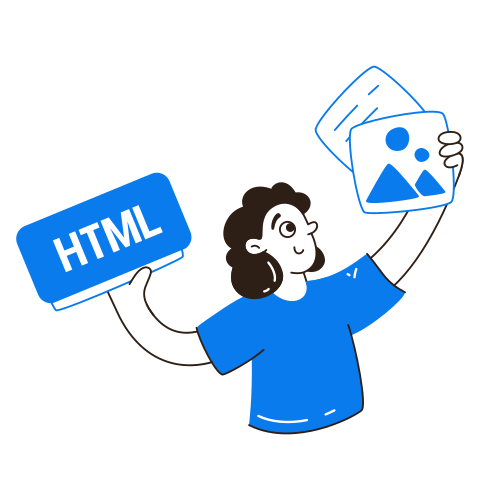
HTML to JSONLines is a specialized digital utility that converts HTML content into the JSONLines (JSONL) data format, which is popular for its line-delimited JSON structure. This tool is especially useful for developers, data analysts, AI engineers, and web scrapers who need to process, import, or analyze large volumes of web or text data in a structured, machine-friendly way.
The core function of any HTML to JSONLines tool is to parse standard HTML—be it a webpage or a snippet—and extract desired data fields, such as text, links, or metadata. This content is then reformatted into JSON objects, with each object placed on a separate line for efficient downstream processing.
For instance, imagine extracting a list of article headlines and links from a news website’s HTML. You simply paste the HTML into the tool, specify which elements to target (like headlines and URLs), and the tool outputs each article’s data as a separate JSON object on its own line—ideal for feeding into big data workflows or machine learning pipelines.
This line-by-line output is particularly valuable for tools or scripts that process data incrementally, ensuring each piece of information is accessible and easily parsed.
A key benefit of using an HTML to JSONLines converter is accuracy. The transformation ensures that all extracted data matches user-defined selectors, minimizing the chance of missing or malformed entries.
This tool also greatly increases convenience. Manual parsing of HTML is tedious and error-prone, while automated conversion accelerates workflows, saving significant time for developers and analysts.
Another advantage is performance. JSONLines is highly efficient for handling large datasets, as each line can be read, indexed, or streamed independently without loading the entire file into memory.
Finally, such tools often provide customizable settings for handling nested elements, special HTML encodings, or optional fields, enhancing their versatility for diverse data extraction needs.
Experienced users recommend validating your HTML before conversion, as well-structured markup leads to better and more accurate JSONL results. When possible, use CSS selectors to target precisely the elements you want—this improves both speed and output consistency.
Note: Some tools may struggle with highly complex or irregular HTML. Always review your output and consider post-processing scripts for cleaning or normalization where needed.
Alternatives to HTML to JSONLines tools include manual scripting with Python (using libraries like BeautifulSoup), or converting HTML into CSV or XML formats instead. However, JSONLines is preferred for its simplicity with big data tools, while CSV is often used for spreadsheets and XML for legacy integration. Choose the tool that best matches your workflow for compatibility and speed, and trust tools with transparent data handling policies for sensitive projects.
This guidance is based on hands-on experience with multiple HTML to JSONLines utilities and community-recommended best practices. The information reflects repeated testing and feedback from software engineering and data science professionals.
Is JSONLines better than JSON for large datasets? For many streaming or big data applications, the JSONLines format is more practical than standard JSON since each object is on its own line, making it easier to process incrementally.
Can you convert partial or malformed HTML using HTML to JSONLines? Most HTML to JSONLines tools can handle partial HTML, but clean, well-formed markup produces the most reliable results.
Are these tools suitable for bulk web scraping projects? Yes, an HTML to JSONLines converter is ideal for web scraping pipelines, allowing you to transform scraped HTML data into analysis-ready, line-delimited JSON efficiently.
Fast, lightweight, and delightful utilities for everyday work.